At the Sunrise Café...

9A009F00-18C8-4036-8E46-333219C32261_1_201_a

... you can talk 'til dawn.

"So we have created a scenario which has mercifully slowed the virus’s spread, but, as we are now discovering, at the cost..."

"... of a potentially greater depression than in the 1930s, with no assurance of any progress yet visible. If we keep this up for six months, we could well keep the deaths relatively low and stable, but the economy would all but disintegrate. Just because Trump has argued that the cure could be worse than the disease doesn’t mean it isn’t potentially true. The previously unimaginable levels of unemployment and the massive debt-fueled outlays to lessen the blow simply cannot continue indefinitely. We have already, in just two months, wiped out all the job gains since the Great Recession. In six months? The wreckage boggles the mind. All of this is why, [on] some days, I can barely get out of bed. It is why protests against our total shutdown, while puny now, will doubtless grow. The psychological damage — not counting the physical toll — caused by this deeply unnatural way of life is going to intensify.... Damon Linker put it beautifully this week: 'A life without forward momentum is to a considerable extent a life without purpose — or at least the kind of purpose that lifts our spirits and enlivens our steps as we traverse time. Without the momentum and purpose, we flounder. A present without a future is a life that feels less worth living, because it’s a life haunted by a shadow of futility.'... We keep postponing herd immunity, if such a thing is even possible with this virus. A massive testing, tracing, and quarantining regime seems beyond the capacity of our federal government in the foreseeable future... [S]ometimes the only way past something is through it."

Writes Andrew Sullivan in "We Can’t Go on Like This Much Longer" (New York Magazine).

ADDED: Damon Linker may "put it beautifully," but to write  "Without the momentum and purpose, we flounder" is to be on the wrong side of the flounder/founder distinction.

"Flounder" is a fish, and the verb means to struggle, and that takes some "momentum and purpose." To "founder" is to collapse, to fall helplessly to the ground... without momentum.

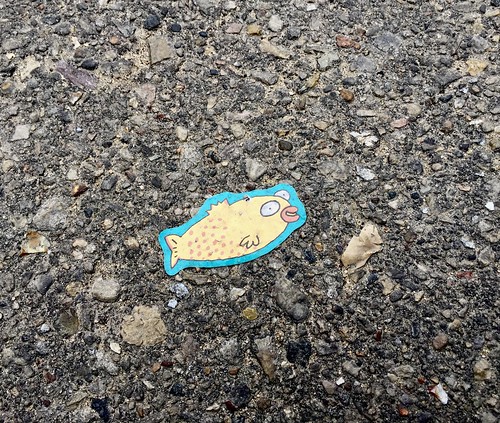
Swimming in asphalt

Movies that begin with a person entering a particular place and end with him leaving.

Help me think of examples of this sequence:

In the first scene, a man (could be a woman) approaches the place (maybe a town). Then, there are many scenes of various people he encounters there and problems that arise. Doesn't matter what. The important thing is the final scene: He's walking away from the place. Could be driving or riding a horse. That's not what matters. What matters is that the only resolution of the story is just that the guy who approached this place is now leaving the place. Nothing about where he's going or what he plans to do next or how he's tied things up or any of that. The resolution is just that he's putting that place behind him.

I saw a movie like that last night. It's a fairly obscure movie, so I'm not going to mention it or encourage you to guess. What I want is to hear about other movies that fit that pattern. Please try to avoid talking about movies that don't fit that pattern.

Also, do you like stories like that? Assuming the things that happen in the place are interesting to watch, are you okay with endings that just have the guy walking out of the town?

ADDED: Here's the movie we watched:


We have big windows behind the TV and, at one point, we saw an owl fly up and land in the tree. We paused and made our own tiny movie. Visually, it's mostly darkness, but you can hear the bird's charming 8-note tune:


The David Sedaris story on which the movie is based is not the one with "owl" in the title. It's "Naked."

"Both waiters and customers wear masks. Diners can remove them to eat and drink..."

"... tucking them safely into an envelope the restaurant provides. Every surface is sanitized every half-hour. Customers have accepted the protocols, [one restaurateur] said. They’ve had to turn away only one for having a slight fever, and sent off a grumpy party of six that wanted to sit together. 'People are honestly much more understanding about everything now,' she said. 'They’re grateful they can go out and feel comfortable.... If you’ve managed to build a brand and built and cultivated integrity, people will trust you when you are allowed to open the door again.'... Is the urge to sit in a restaurant so great that customers will endure an experience that is more like a trip to the dental hygienist? Will they risk infection, even in a place with the safest protocols?... 'At the end of the day, we’re problem solvers and we will find a way to do this,' [said another restaurateur]. 'The restaurant industry is about constant chaos and writing a ballet out of that chaos. We’ve spent all of our careers preparing for this moment.'"

From "Safe Dining? Hard to Imagine, but Many Restaurants Are Trying/Though widespread reopenings may be a long way off, chefs and health officials have begun studying how a post-pandemic restaurant might look" (NYT).

Health has always been something restaurants have had to worry about getting right. Whenever we've gone to a restaurant, we've trusted the place not to damage our health. They make substances in the back room that we inject* into our body. The servers go to the bathroom and we've been trusting that they wash their hands thoroughly. We're more alert now and paying attention. There's a specific new danger on the list of things that could find their way into your body from a restaurant.

Restaurants get to earn our trust all over again, and we get to think carefully about how much we're going to put our lives in their (presumably washed) hands. Some of us, I think, have developed stronger feelings about how much restaurants mean to us, and others are more wary than ever about the agents of disease that lurk there. We all change and adapt. I'd like to think that makes us better and stronger.

___________________

* I'm just needling you. "Inject" means "To drive or force (a fluid, etc.) into a passage or cavity, as by means of a syringe, or by some impulsive power; said esp. of the introduction of medicines or other preparations into the cavities or tissues of the body" (OED). I don't really think "inject" is an accurate way to describe eating (unless it's something like the way geese eat in the production of foie gras).

BUT: Etymologically, the original meaning of "inject" is to throw in. We do speak of throwing back a few drinks.

AND: We do speak of injecting a little humor. We might say that Trump was injecting a little humor when he (lyingly) claimed to have been using sarcasm when words ejected from him that seemed to suggest that disinfectant of the sort that you'd use to wipe down a tabletop could be injected into the human body.

"Density alone doesn’t seem to account for the scale of the differential between New York’s fatality rates and those of other cities."

"New York has twice the density of London but three times the deaths, and the differential is even higher [comparing NYC to] cities such as San Francisco and Los Angeles. Deaths have occurred disproportionately in poorer areas, where the incidence of long untreated morbidities such as heart disease and diabetes have contributed significantly. But the same is true in all other cities. The high dependence on mass transit also seems to be a factor. In other major cities, car commutes are much more common. As Joel Kotkin, a scholar of cities at Chapman University in California, says, it may be the lethal convergence of all three factors. 'If you put together density, levels of poverty and reliance on a mass-transit system, you have a hat trick,' he told me.… But even that may not explain the extent of New York’s unique catastrophe. Around the world, the highest death rates have occurred where hospital systems were overwhelmed in the early stages of the crisis. This is especially true in northern Italy. Anecdotally, at least, it seems that the same happened in New York: Large numbers of sick people never got to hospitals, arrived too late or, in the impossible circumstances that medical personnel were confronted with, were given ineffective treatment.… It will be a while before we get a proper understanding of what went so tragically wrong...."

From "The Covid-19 Catastrophe Unfolding in New York Is Unique" (Wall Street Journal), quoted at my son John's Facebook page.

John writes:
I'm not sure this is a logical argument:
"Density alone doesn’t seem to account for the scale of the differential between New York’s fatality rates and those of other cities. New York has twice the density of London but three times the deaths, and the differential is even higher for cities such as San Francisco and Los Angeles."
Doesn't that assume there's a linear relationship between density and infection rates, and isn't that not necessarily the case?
My question is about the comparison of New York to northern Italy, where hospitals were overrun. Were NY hospitals overrun? I thought they weren't.  I think the 3 factors named — density, reliance on mass-transit, and the bad health conditions represented by the term "poverty" — are enough to explain what happened. These things are interactive. Shouldn't we talk about Bayes theorem?

A great Anthony Fauci impersonation by Brad Pitt (on "Saturday Night Live" last night).

Who knew Brad Pitt could do impersonations? Some good satirizing of Trump rhetoric, as "Fauci" explains what Trump is really trying to say:

A day after his inflammatory, incoherent disinfectant-injection remarks, Trump announces that his long press briefings are not worth his time and effort.